The Fall of Phaeton
Peter Paul Rubens · c. 1604/1605, probably reworked c. 1606/1608 · oil on canvas
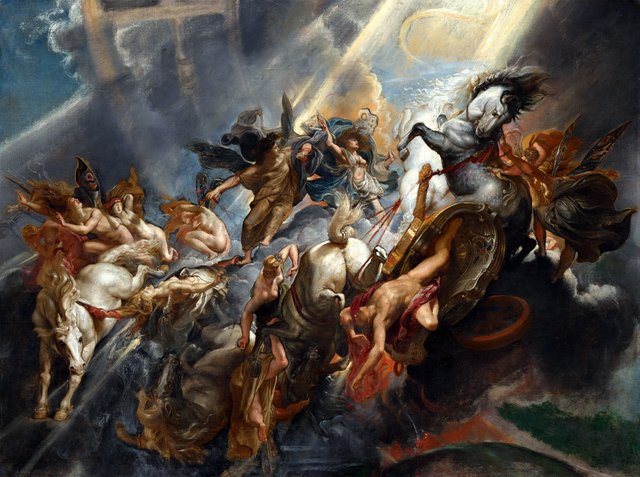
The Fall of Phaeton is a painting by the Flemish master Peter Paul Rubens, featuring the ancient Greek myth of Phaeton (Phaethon), a recurring theme in visual arts. Rubens chose to depict the myth at the height of its action, with the thunderbolts hurled by Zeus to the right. The thunderbolts provide the light contrast to facilitate the display of horror on the faces of Phaeton, the horses and other figures while preserving the darkness of the event. The butterfly winged female figures represent the hours and seasons, who react in terror as the night and day cycle becomes disrupted. The great astrological circle that arches the heavens is also disrupted. The assemblage of bodies form a diagonal oval in the center, separating dark and light sides of the canvas. The bodies are arranged so as to assist the viewer's travel continually around that oval.
Image courtesy of The National Gallery of Art.
Available as a made-to-order museum-quality canvas print: stretched or framed.